Avocado OS: A Four-Model DeepStream Vision Pipeline on Jetson Orin Nano in ~14 Minutes
TL;DR — We made a demo with some fancy people tracking! Runs on the GPU at 30fps, tracks people, poses, and hands, draws fun lines. Fresh Jetson Orin Nano to fully flashed and running: about 14 minutes, and none of it compiles on the device.
The fast path to a complex pipeline
This is a moderately complex vision pipeline: four TensorRT engines — PeopleNet (detect people), MoveNet (17-point skeleton per person), YOLOX-Body-Head-Hand (find hands), and MediaPipe Hand Landmark (21 keypoints per hand) — linked by an NvDCF tracker, with nvdsanalytics ROI dwell timers on top and every overlay burned into a live MJPEG stream. The usual ways to stand that up — an nvcr.io pull onto a workstation, a multi-hour Yocto build, or compiling engines on first boot — don't fit something that has to ship and update in the field.
The whole stack, DeepStream 7.1, TensorRT, CUDA, cuDNN, the NVIDIA GStreamer plugins, pyds, Python, and Flask — is already precompiled in the Avocado package feed. avocado install pulls the prebuilt packages; avocado build assembles them into sysext extensions. No Docker daemon, no Yocto build from source, nothing compiled on target.
Roughly nine minutes to download every package. One minute, fifteen seconds to build the image.
How to get started
Here is all that is needed, all commands run on your machine
avocado init --reference nvidia-deepstream nvidia-deepstream
cd nvidia-deepstream
avocado install -f      # pull the SDK + prebuilt runtime packages from the feed
avocado build           # download models/engines, assemble the five extensions
avocado provision -r dev --profile tegraflash   # flash the Orin Nano over USB
Measured on a Jetson Orin Nano DevKit:
| Step | What happens | Observed time |
|---|---|---|
init | clone the reference + assets | seconds |
install | pull every package: DeepStream 7.1, CUDA/cuDNN, TensorRT, GStreamer NV plugins, Python, Flask, plus the four models and prebuilt engines | ~9 min, network-bound |
build | compose the five extensions into the image filesystem | 1 min 15 s |
provision | tegraflash the board over USB recovery mode | ~3.5 min |
The ~9-minute download is the only variable — it scales with your internet connection, because DeepStream and CUDA are genuinely big. None of it is compilation; install is bytes on the wire, not CPU. The 1:15 assemble is the actual build, and it's short precisely because there's no source to compile.
After the flash, the board reboots straight into the pipeline — open http://<device-ip>:8080 and you're looking at the live feed. Toggle the Center zone to count people walking into it; flip on the skeleton, pose, and hand overlays to watch keypoints track across the room, all on the GPU. (Testing the reference has the health checks.)
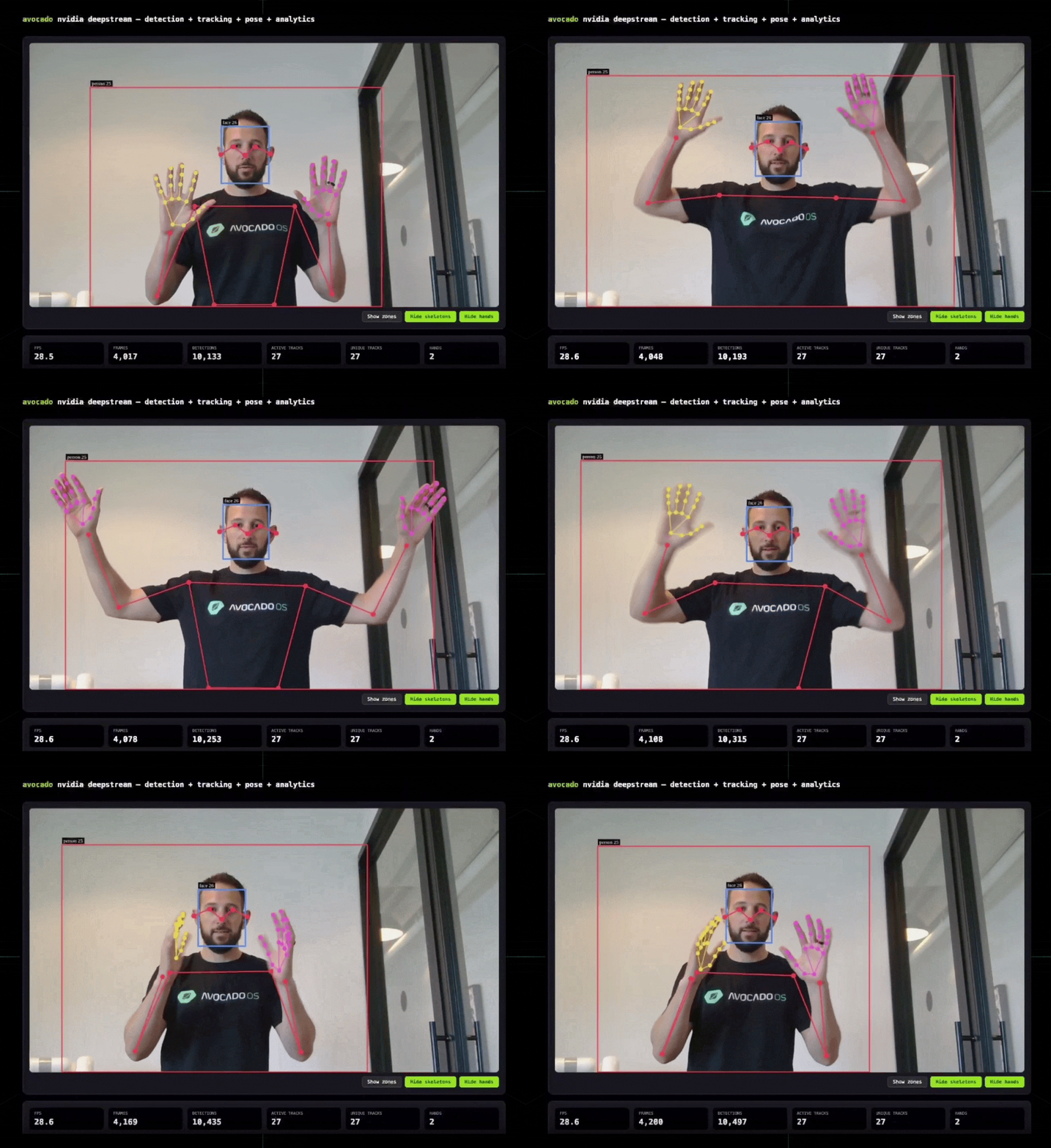
The live dashboard on a Jetson Orin Nano: pose and hand tracking on, tracker IDs stable across the frame, and the zone counter incrementing — all rendered on the GPU.
Implementation
Stack
| Layer | Choice | Notes |
|---|---|---|
| Inference SDK | NVIDIA DeepStream 7.1 | The target framework, precompiled in the Avocado feed. Its nvinfer / nvtracker / nvdsanalytics GStreamer elements are the whole pipeline. Runs native - no container. |
| Inference backend | TensorRT (FP16 engines) | FP16 over INT8: faster engine build, near-identical accuracy on this workload, stays real-time at 720p. INT8 (with calibration) is a regenerate-and-commit task per target if a deployment is throughput-bound. |
| GPU runtime | CUDA cudart + libraries, cuDNN | Prebuilt packages from the feed, not a CUDA container and not a from-source build. Lives in the runtime layer; only moves on a JetPack bump. |
| Media framework | GStreamer 1.0 + NVIDIA plugins (nvvideoconvert, nvv4l2camerasrc, nvjpegenc, nvvidconv) | The pipeline graph. Hardware JPEG encode (nvjpegenc) is fed straight from NVMM NV12, which keeps OpenCV and numpy off the dependency list entirely. |
| Camera | v4l2src + kernel-module-uvcvideo | USB UVC webcam, MJPEG path. CSI (nvarguscamerasrc) and RTSP (rtspsrc) are documented one-line swaps; everything downstream of nvstreammux is source-agnostic. |
| Detector (primary) | PeopleNet ResNet34, 3 classes (Person/Bag/Face) | NVIDIA TAO model from NGC. Drop-in swap to TrafficCamNet / DashCamNet via a config edit. |
| Tracker | NvDCF (perf profile) | Correlation filter + visual features. Biased toward speed; accuracy and IOU-only profiles ship with DeepStream samples for the swap. |
| Pose (secondary GIE) | MoveNet single-pose Lightning | Runs only on PeopleNet's Person crops. ONNX rewritten NHWC to NCHW at build time so DS 7.1 nvinfer reads it cleanly. |
| Hand detect (primary GIE) | YOLOX-Body-Head-Hand 320x320 | One cheap 320x320 pass on the full frame finds hands directly, with no dependence on the person bbox being right first. Raw head output (grid + log-space + sigmoid) is decoded and NMS'd in the Python pad probe. |
| Hand landmark (tertiary GIE) | MediaPipe Hand Landmark sparse 224x224 | The sparse 224x224 variant keeps the per-hand crop inference small enough to run on every detected hand without dragging the pipeline below real-time; emits 21 keypoints + handedness + presence. |
| App runtime | Python 3 + PyGObject + Flask | Prebuilt packages from the feed (python3-flask, python3-pygobject), not pip. Lives in the runtime layer so a logic change does not re-ship the interpreter. |
| Dashboard transport | Flask MJPEG | "Open it in a browser" simplicity. RTSP out (nvv4l2h264enc + rtspclientsink) is a documented swap for the DeepStream-idiomatic path. |
App / source layout
nvidia-deepstream/
├── avocado.yaml                      # five-extension dev runtime, SDK compile hooks
├── models-compile.sh                 # download + rewrite the four ONNX (SDK)
├── models-install.sh                 # stage ONNX into vision-models sysroot
├── engines-compile.sh                # stage prebuilt engines for $AVOCADO_TARGET
├── engines-install.sh                # stage engines into vision-engines sysroot
├── prebuilt-engines/
│   └── jetson-orin-nano-devkit/      # committed FP16 engines, one dir per model
│       ├── peoplenet/    *.engine
│       ├── movenet/      *.engine
│       ├── handdet/      *.engine
│       └── handlandmark/ *.engine
├── vision-models/overlay/usr/lib/nvidia-deepstream/models/
│   └── peoplenet/labels.txt          # committed; ONNX fetched at build
├── vision-config/overlay/etc/nvidia-deepstream/
│   ├── config_infer_peoplenet.txt    # primary GIE
│   ├── config_infer_movenet.txt      # secondary GIE (pose)
│   ├── config_infer_handdet.txt      # primary GIE (hands)
│   ├── config_infer_handlandmark.txt # tertiary GIE
│   ├── tracker_NvDCF.yml             # NvDCF perf profile
│   └── analytics_config.txt          # ROI + line-crossing definitions
└── vision-app/overlay/usr/
    ├── local/bin/app.py              # ~2,000 lines: the pipeline + Flask dashboard
    ├── lib/systemd/system/vision-app.service
    └── libexec/avocado-deepstream-preflight.sh
The pipeline
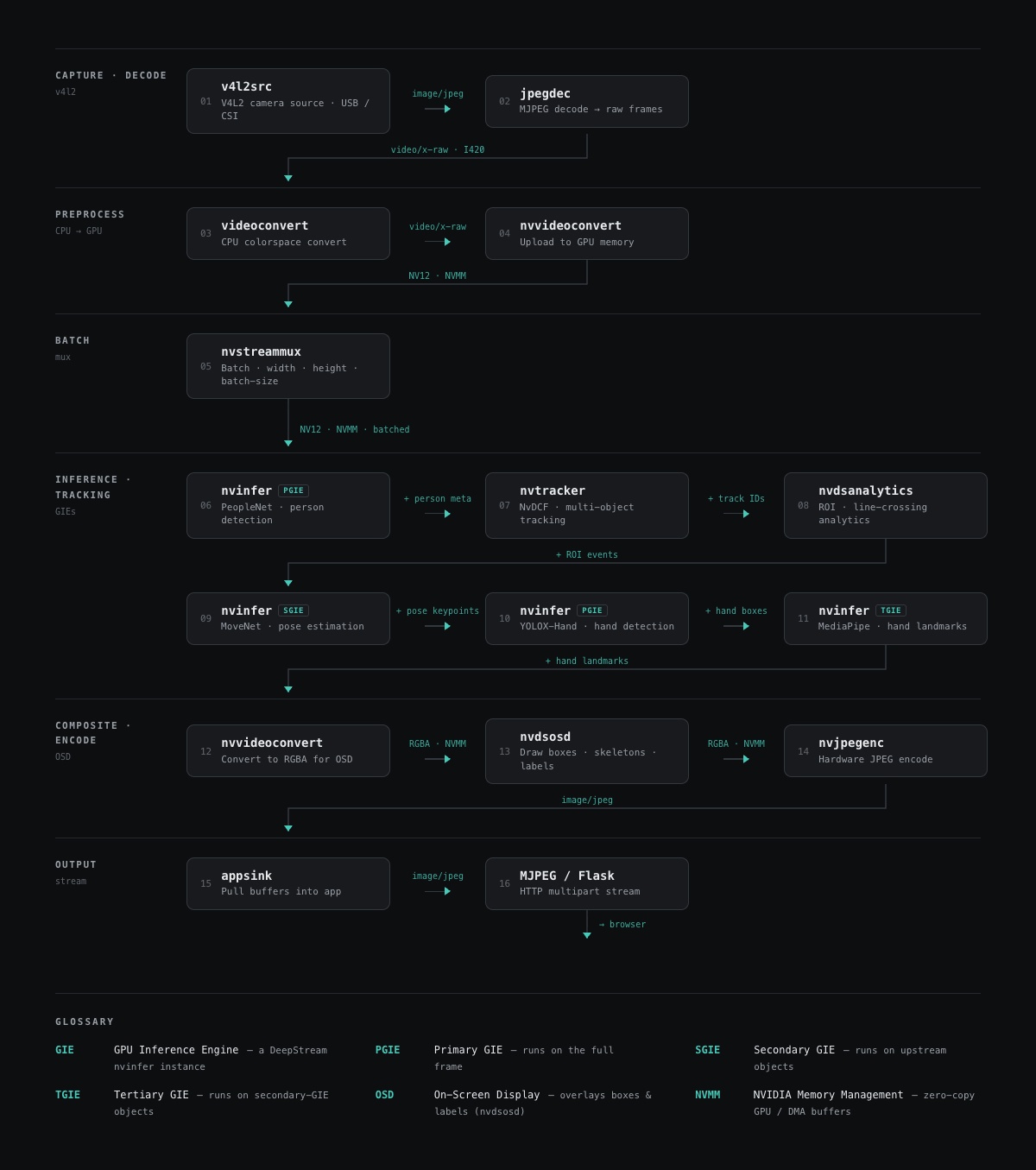
Detection metadata travels as NvDsBatchMeta attached to each buffer; app.py reads it through the pyds bindings. Frame pixels travel separately and land in the appsink already JPEG-encoded by nvjpegenc, so the MJPEG relay copies bytes rather than re-encoding in Python.
The pose and hand stages each deliver their model output as NvDsInferTensorMeta (output-tensor-meta=1, network-type=100 to disable nvinfer's built-in post-processing). The pad probe reads the raw tensor via tensor_meta.out_buf_ptrs_host - the canonical pyds path, a void** PyCapsule walked with ctypes - projects keypoints back into image-pixel coordinates, and attaches an NvDsDisplayMeta of joint circles and bone lines. nvdsosd rasterises that into the same frame it paints the box onto. The overlay arrives in the MJPEG stream at full pipeline frame rate with no client-side rendering.
Endpoints
| Method | Path | Purpose |
|---|---|---|
| GET | / | HTML dashboard: live video, FPS/detection/track stats, overlay toggle buttons |
| GET | /stream | Raw multipart/x-mixed-replace MJPEG stream with overlays burned in |
| GET | /api/stats | JSON: FPS, detections, unique_tracks, pose state, and the analytics block (per-ROI current_count, total_entries, avg_dwell_seconds, line crossings) |
| POST | /api/toggle/skeletons | Flip the server-side skeleton overlay flag (default off) |
| POST | /api/toggle/hands | Flip the hand-keypoint overlay flag (default off) |
| POST | /api/toggle/zones | Flip the ROI/line overlay flag (default off) |
The toggles flip a flag the pad probe reads each frame, so the change takes effect on the next frame with no service restart. The current state is reported back under pose.overlay_enabled in /api/stats.
The build flow
avocado build runs the compile hooks inside the SDK container and assembles all five extensions. The hooks fetch and prep the four models:
- PeopleNet ONNX + labels from NGC - the primary detector.
- MoveNet single-pose Lightning from PINTO's ONNX zoo. Its input layer is rewritten from NHWC to NCHW with a small
onnx.helperTranspose insertion so DS 7.1nvinferreads it cleanly. This rewrite is why the extension declares an SDK dependency onnativesdk-uv- the only SDK prerequisite in the reference, and one to flag for anyone porting it. - YOLOX-Body-Head-Hand (320x320, non-post variant) from PINTO - the hand detector.
- MediaPipe Hand Landmark sparse (224x224) from PINTO - the hand-landmark regressor.
engines-compile.sh (the vision-engines hook) reads $AVOCADO_TARGET and stages only prebuilt-engines/$AVOCADO_TARGET/. Because every Avocado build is custom to the target, the resulting extension always contains exactly the right engines for the image. The script fails the build if any of the four models lacks an engine for the target rather than producing an image that cannot start:
TARGET="${AVOCADO_TARGET:-jetson-orin-nano-devkit}"
ENGINE_SRC_BASE="prebuilt-engines/${TARGET}"
for model in peoplenet movenet handdet handlandmark; do
  src_dir="$ENGINE_SRC_BASE/$model"
  if [ -d "$src_dir" ] && ls "$src_dir"/*.engine >/dev/null 2>&1; then
    cp -v "$src_dir"/*.engine "$ENGINE_DST_BASE/$model/"
  else
    echo "ERROR: no engine for '${model}' under ${src_dir}/." >&2
    exit 1
  fi
done
Packaging: five extensions, one reason to change each
The pipeline is split across five extensions, each with a single reason to change. systemd-sysext merges the sysext layers into one /usr and the confext layers into /etc at boot, so the split is invisible to the running app. There is no inter-extension dependency mechanism in systemd; the dev runtime's extension list in avocado.yaml is the contract that all five are composed together.
| Extension | Type | Holds (sysext = /usr, confext = /etc) | Re-ships when | Rough size |
|---|---|---|---|---|
vision-runtime | sysext + confext | DeepStream, pyds, TensorRT, CUDA/cuDNN, NVIDIA GStreamer plugins, uvcvideo, Python + Flask (the dependencies). The confext half carries the packages' /etc/ld.so.conf.d/*.conf entries. | JetPack / DeepStream / CUDA bump (rare) | GB-scale |
vision-models | sysext | the four ONNX files under /usr/lib/nvidia-deepstream/models/ | a model is retrained or swapped | ~31 MB |
vision-engines | sysext | prebuilt TensorRT engines for the build target under /usr/lib/nvidia-deepstream/engines/ | models change, or a TRT/JetPack bump | ~19 MB |
vision-config | confext | nvinfer / tracker / analytics configs under /etc/nvidia-deepstream/ | retuning thresholds, ROI zones, tracker profile | KB |
vision-app | sysext | app.py, its systemd unit, the preflight script (the code) | business-logic iteration (frequent) | KB |
The same precompiled-feed property that makes the first build fast makes every subsequent update small. Because the gigabytes of CUDA and DeepStream live in their own vision-runtime layer and are never compiled locally, they only move on a JetPack bump - and the OTA for a day-to-day change carries only the layer you touched: a kilobyte confext for a retuned threshold, a kilobyte sysext for an app.py edit, tens of megabytes for a retrained model.
vision-runtime is both a sysext and a confext — the non-obvious call. CUDA, TensorRT, and DeepStream ship their libraries under /usr and /opt (sysext), but they also drop /etc/ld.so.conf.d/*.conf entries (confext) that tell ldconfig where those libraries live. Ship it sysext-only and the loader never finds them — one of two ways we hit no element "nvvideoconvert" (see Issues Encountered). So the runtime layer carries both halves.
Writable state: none in /var. Models and engines are read directly from their read-only extensions, so an A/B extension swap fully replaces them with nothing to reconcile. The only runtime-writable state is the curated GStreamer plugin directory under /run (tmpfs), rebuilt on every start (see the unit shape below).
The three lower layers (vision-models, vision-engines, vision-config) carry an on_merge: systemctl try-restart vision-app.service hook, so an OTA of just those layers restarts the app to pick up the new artifacts without a reboot. vision-app owns the service: it enables it, restarts on merge, and stops it on unmerge.
systemd unit shape
The interesting part of vision-app.service is the ExecStartPre workaround and the immutability discipline around it. The pipeline needs the GPU and the camera, so it runs with the device access it requires.
[Service]
Type=simple
ExecStartPre=/usr/libexec/avocado-deepstream-preflight.sh
Environment=GST_PLUGIN_SYSTEM_PATH_1_0=/run/avocado-gst-plugins
ExecStart=/usr/bin/python3 /usr/local/bin/app.py
Restart=on-failure
RestartSec=5
TimeoutStartSec=180
Environment=GST_DEBUG=2,nvinfer:4
The ExecStartPre preflight exists to dodge a GStreamer plugin-scanner crash — the second half of the no element "nvvideoconvert" saga in Issues Encountered. It builds a directory under /run with symlinks to every real plugin except the offending libcustom2d_preprocess.so, and the unit points GST_PLUGIN_SYSTEM_PATH_1_0 at it. Defining the system path overrides rather than augments the built-in default, so /usr/lib/gstreamer-1.0 is never scanned directly. The script writes only to /run (tmpfs, rebuilt each start) and never overlays or bind-mounts /usr, /etc, or /opt - any in-place modification of those would break avocado runtime deploy, because systemd-sysext's unmerge bails with "Read-only file system" if anything is mounted onto a path it needs to walk.
TimeoutStartSec=180 is headroom: the four FP16 engines are memory-mapped on load, so the pipeline normally reaches PLAYING in ~10-15 s, but a slow SD card mmapping four engines gets the slack it needs. GST_DEBUG=2,nvinfer:4 keeps nvinfer chatty in the journal during load so startup shows progress rather than silence. Camera device, resolution, framerate, port, and the per-stage ENABLE_POSE / ENABLE_HANDS switches are all commented-out Environment= lines, overridable with systemctl edit vision-app and no rebuild.
Testing the reference
Verify
SSH in (the development config extension sets an empty root password):
ssh root@<device-ip>
Runtime and service are up:
avocadoctl runtime list        # the dev runtime is running
systemctl status vision-app    # Active: active (running)
Pipeline reached PLAYING and produced frames:
journalctl -u vision-app -b --no-pager | tail -30
# ...setting pipeline to PLAYING
# dashboard:        http://0.0.0.0:8080
Dashboard and live stream, from any machine on the same network:
- Browser:
http://<device-ip>:8080- live video with boxes, per-object tracker IDs, and a stats panel. - Raw stream:
http://<device-ip>:8080/stream - JSON:
curl http://<device-ip>:8080/api/stats | jq
Expected on an Orin Nano at 720p: ~30 fps end-to-end with a couple of people in frame.
Tracker IDs persist across frames - walk in and out of frame and watch a stable id stay attached to each person while unique_tracks increases each time someone new enters:
curl -s http://<device-ip>:8080/api/stats | jq '.unique_tracks, .analytics.rois.Center'
# 3
# {
#   "current": [{"tracker_id": 17, "elapsed_seconds": 8.2}],
#   "current_count": 1,
#   "total_entries": 27,
#   "avg_dwell_seconds": 7.4
# }
Flask does not bind port 8080 until all four GIEs' engines are loaded. If the dashboard is unreachable on first boot, journalctl -u vision-app -f shows which engine nvinfer is on.
Try it yourself
- Toggle overlays live. With the dashboard open, click Show skeletons, Show hands, Show zones. Each is a
POST /api/toggle/...that flips a flag the pad probe reads next frame - no restart, visible immediately. - Benchmark the stages.
systemctl edit vision-app, setEnvironment=ENABLE_HANDS=0, restart, and read the FPS delta in/api/stats. AddENABLE_POSE=0to see the detector + tracker pipeline alone. - Reconfigure the camera with no rebuild. Set
CAMERA_DEVICE/CAMERA_WIDTH/CAMERA_HEIGHTin a drop-in, restart, and watch the pipeline rebuild its caps from the new values.
Issues Encountered
TensorRT engines have to be built on the target first. Engines are specific to the GPU and TensorRT version — there's no cross-building them on a workstation. So the real workflow is: build the four FP16 engines once on the Orin Nano (under 10 minutes), copy them back off the device, and commit them under prebuilt-engines/<target>/ to embed in the vision-engines extension. Every build and OTA after that ships those prebuilt engines — no device ever compiles on boot.
The first cut was one big extension. It worked, but every OTA was enormous: a one-line app.py change re-shipped CUDA and DeepStream. Splitting into five extensions along lines of change — runtime / models / engines / config / app — drops a code-only update from gigabytes to kilobytes. Separation of concerns here is an OTA-size decision, not a stylistic one.
no element "nvvideoconvert" — the same error twice, from two unrelated causes. The first time, ldconfig couldn't find the CUDA and DeepStream libraries: those packages drop /etc/ld.so.conf.d/*.conf entries that point the loader at their install dirs, and shipping vision-runtime as a sysext without its confext half silently dropped them — so the GStreamer plugins couldn't dlopen their dependencies. (That's why the runtime layer carries both halves.) The second time — libraries found, still no nvvideoconvert — the culprit was the plugin scanner itself: deepstream-7.1 ships /usr/lib/gstreamer-1.0/deepstream/libcustom2d_preprocess.so, which isn't a plugin at all (it belongs to the unused nvdspreprocess). Its constructor throws pthread_setspecific: Invalid argument inside glib, the scanner aborts, and on the way down it blacklists the next file alphabetically — libgstnvvideoconvert.so. Same three words on screen; a loader-path bug and an alphabetical-blacklist bug behind them. The fix for the second is the ExecStartPre preflight in the systemd unit.
Compose with other references
This is the heavy end of the repo's NVIDIA vision line. nvidia-gstreamer-yolo is the lighter companion: the same GStreamer-on-NVIDIA shape with a single YOLO detector and no DeepStream SDK, useful when the multi-model DeepStream stack is more than the product needs. python-yolo is the non-accelerated baseline for comparison. The five-extension packaging pattern here - dependencies / weights / target-pinned artifacts / config / code - transfers to any model-serving reference, NVIDIA or not.