HummingBoard RZ/V2N AIOT
Industrial-grade Physical AI platform with 15 Sparse / 4 Dense TOPS DRP-AI3, real-time Cortex-M33, and ruggedized industrial connectivity.
rzv2n-sr-som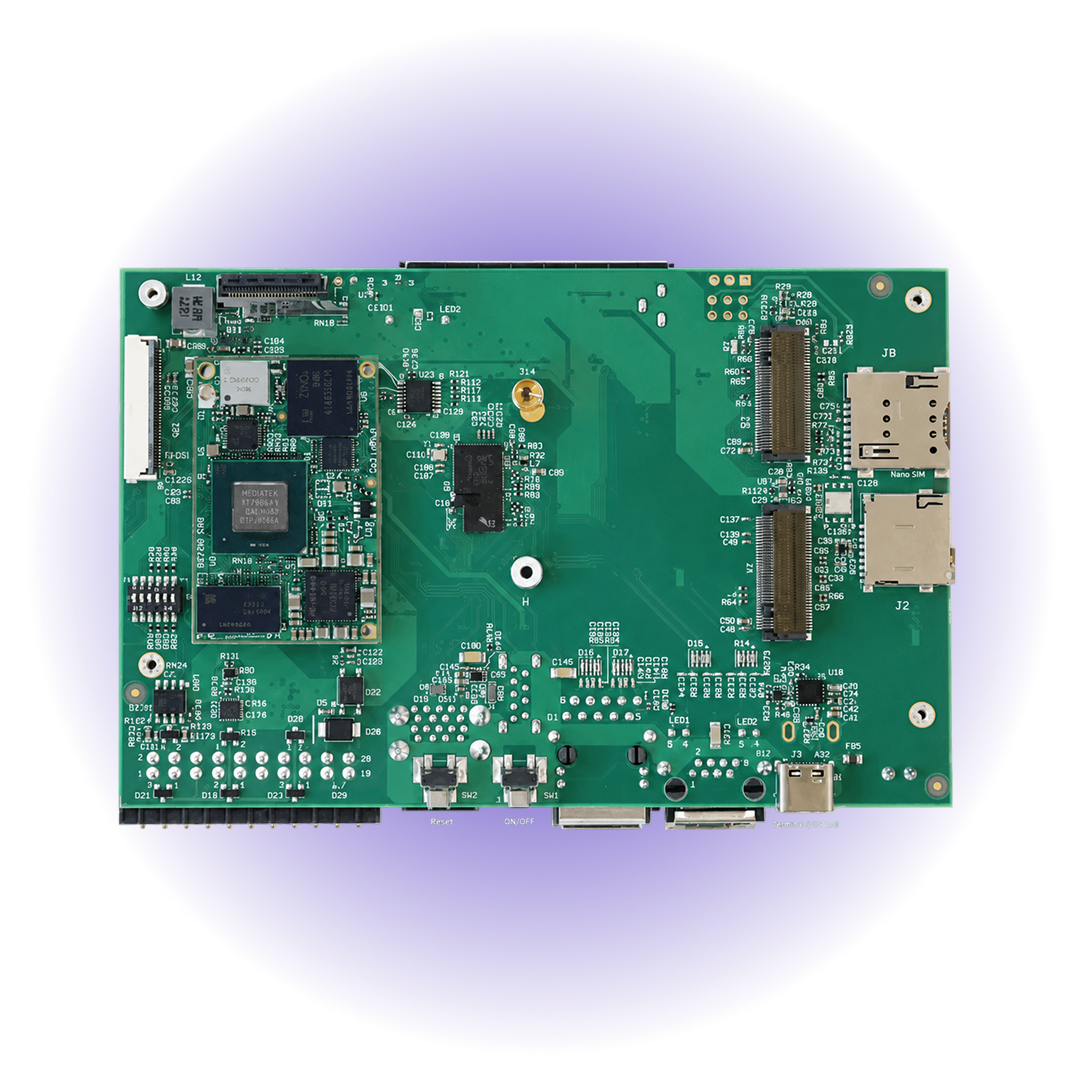
- 15S / 4D TOPSDRP-AI3 NPU
- Quad A55 + M33Multi-Core Processing
- 8 GB LPDDR4Memory
- 2x GbE + Wi-FiIndustrial Networking
- -40°C to +85°CIndustrial Temperature
- 4K Encode / DecodeVideo Pipeline
Overview
The SolidRun HummingBoard RZ/V2N AIOT, powered by Avocado OS and Peridio Core, delivers a production-ready platform for Physical AI applications that demand on-device vision, real-time control, and industrial-grade deployment. Built on the Renesas RZ/V2N SoM with quad Arm Cortex-A55 cores up to 1.8 GHz, a Cortex-M33 real-time core, and the DRP-AI3 accelerator delivering 15 Sparse / 4 Dense TOPS, this compact industrial SBC enables sophisticated computer vision, multi-sensor fusion, ROS 2 robotics, and HMI workloads at the edge — without cloud dependency. Dual Gigabit Ethernet, optional PoE, optional LTE, RS232/RS485 serial, dual CAN-FD, and MIPI-DSI display support make it a true industrial gateway, while a -40°C to +85°C temperature range and optional extruded aluminum enclosure handle harsh environments. Combined with Avocado OS — atomic OTA updates, secure boot, verified boot, and fleet-wide CVE tracking — and Peridio Core's centralized fleet management, the platform replaces 12+ months of BSP and infrastructure work with a complete, validated stack ready for production.
Specifications
| Specification | Value | Notes |
|---|---|---|
| SoM | Renesas RZ/V2N | Vision-AI optimized industrial SoC |
| CPU | Quad Cortex-A55 @ up to 1.8 GHz | Application processors for Linux workloads |
| Real-Time Core | Cortex-M33 | Dedicated real-time control processing |
| AI Accelerator | DRP-AI3, 15 Sparse / 4 Dense TOPS | On-device vision AI without cloud dependency |
| Memory | Up to 8 GB LPDDR4 | High-bandwidth memory for vision pipelines |
| Storage | Up to 128 GB eMMC + microSD | On-board storage with removable media support |
| Camera | 1× MIPI-CSI (4 lanes) | Production camera module support |
| Video | 4K Encode / 4K Decode | Hardware-accelerated video pipeline |
| Display | MIPI-DSI | Industrial HMI display support |
| Networking | 2× Gigabit Ethernet RJ45, Wi-Fi a/b/g/n/ac, Bluetooth | Dual wired + dual-band wireless connectivity |
| Cellular | M.2 B-Key LTE (eSIM, NanoSIM) | Optional cellular for remote sites |
| Industrial I/O | 2× RS232, 2× RS485 (or RS232 + RS485), 2× CAN-FD | Drop-in factory floor integration |
| USB | 1× USB 3.2, 2× USB 2.0 | Peripheral and accessory expansion |
| Power | 7 V – 32 V wide input, PoE 802.3at, reverse polarity protection | Flexible powering for industrial deployments |
| Operating Temp | -40°C to +85°C | Industrial and harsh environments |
| Dimensions | PCBA 88 × 135 mm; optional enclosure 150 × 145 × 40 mm | Compact SBC with optional aluminum enclosure |
Use Cases
Smart Camera & Computer Vision
On-device inference for defect detection, classification, and quality control. The DRP-AI3 NPU runs production vision models natively via TensorFlow, PyTorch, and ONNX, with fleet-wide model updates delivered over the air across thousands of deployed devices.
Industrial Automation & HMI
Machine vision, process control, and operator interfaces on the factory floor. RS232, RS485, dual CAN-FD, and optional PoE provide drop-in integration into existing industrial environments, while MIPI-DSI display support enables responsive HMI workflows alongside real-time control on the Cortex-M33.
Autonomous Machines & Robotics
Multi-sensor fusion and on-device perception for ROS 2-based robotics and autonomous systems. The DRP-AI3 accelerator and quad-core Cortex-A55 handle vision and decision-making, while the Cortex-M33 manages real-time motion and sensor loops — a complete Physical AI compute stack in a single SBC.
Challenges and Solutions
| Challenge | Solution |
|---|---|
| 12+ months of custom BSP integration | Pre-integrated Avocado OS BSP for the RZ/V2N SoM |
| Building OTA and fleet infrastructure from scratch | Peridio Core: OTA, observability, fleet management |
| Deploying and updating vision models in the field | Fleet-wide model updates over the air |
| Coordinating Linux + real-time workloads (A55 + M33) | Pre-integrated multi-core support |
| Industrial-grade reliability requirements | -40°C to +85°C operation with industrial I/O and aluminum enclosure |
| Securing devices across distributed deployments | Secure boot, verified boot, FDE, fleet-wide CVE tracking |
| Long-lived production fleets | LTS aligned with CIP™ for 10-year lifecycle support |
Key Features
Industrial-Grade OS
Avocado OS provides a production-hardened, Yocto-based embedded Linux runtime with deterministic builds, secure boot, verified boot, and full-disk encryption out of the box.
DRP-AI3 NPU Acceleration
15 Sparse / 4 Dense TOPS of on-device AI acceleration on the Renesas RZ/V2N, with native support for TensorFlow, PyTorch, and ONNX plus a comprehensive vision library and dataflow compiler — designed specifically for vision-heavy Physical AI workloads.
Real-Time Processing
A dedicated Cortex-M33 real-time core handles latency-sensitive tasks — motor control, sensor polling, and deterministic I/O — while the quad Cortex-A55 cores up to 1.8 GHz run the Linux application stack.
Industrial Connectivity
Dual Gigabit Ethernet with optional PoE 802.3at, optional LTE cellular, Wi-Fi/Bluetooth, RS232, RS485, dual CAN-FD, and MIPI-DSI HMI display — drop-in connectivity for factories, perimeters, and remote sites with a 7–32 V wide-input power range.
Fleet Management
Peridio Core delivers atomic OTA updates with delta compression, A/B rollback, staged rollouts, fleet dashboard, health monitoring, remote debugging, and secure tunnel access.
Long-Term Support
LTS commitments aligned with the Civil Infrastructure Platform (CIP™), whose kernels target a 10-year lifecycle, ensure your fleet stays patched, supported, and shippable for the long haul.
Getting Started
Init, Install, & Build
Follow the Any Supported Target instructions under Getting Started to begin. This target is rzv2n-sr-som. The provisioning specifics are below.
Provision
Build the project and execute the provisioning procedure. This will build the system image and flash it to your target hardware.
If your Linux desktop auto-mounts removable media, disable it first — see Linux Auto-Mounting.
avocado build
avocado provision -r dev --profile sd
Run
After provisioning completes, insert the microSD card into your target device and power it on.
The device will boot from the microSD card with the provisioned system. The root user is passwordless in the dev runtime used by this guide.
For board-level setup details — power, console, boot mode selection, and peripheral wiring — see SolidRun's HummingBoard RZ/V2N IIoT SBC Quick Start Guide.